
Finding People Across National City
The best first record depends on the fact already in hand. A full name may lead to recorded deeds, court parties, professional licenses, or business filings. A National City street address works better in parcel and permit systems. A school, graduation era, or family tie points toward yearbooks, city directories, and newspapers. Phone-based searching is less common in official databases, so use a number to identify an agency or business, then verify the person through its public directory or filing.
National City is not the county seat. Many core records sit with San Diego County or California agencies, even when the person lived inside city limits. Keep name variants in play, including compound surnames and prefixes such as de la, La, San, or Santa. Trust and business names can also appear where a personal name was expected.
- Write down the name, former address, date range, and relationship that can distinguish the right person.
- Check the county recorded-document index and court party index for a name-based trail.
- Turn an address into a parcel number, then use assessor, tax, and deed channels to trace it.
- For family or classmate research, compare yearbooks, directories, newspapers, and probate records.
- Use the City Clerk request portal only after checking records that National City has already published.
Note: A shared name is not proof of identity; compare dates, places, document types, and known relatives before treating two records as one person.
National City Records Office Routes
Three offices form the practical center of a National City people search. San Diego County ARCC records deeds and liens, maintains county vital records, and provides assessor information. The Superior Court holds case files and probate matters. National City's City Clerk maintains municipal records, election material, minutes, ordinances, resolutions, and local request channels. Each office answers a different part of the identity trail.
San Diego County ARCC
Real Estate Records
P.O. Box 121750, San Diego, CA 92112-1750
(619) 237-0502
San Diego Superior Court
Central Courthouse
1100 Union Street, San Diego, CA 92101
Older Records: (619) 844-2400
Court files and certified copies
National City City Clerk
1243 National City Boulevard
National City, CA 91950-4301
(619) 336-4228
ARCC Assessor Public Information uses a separate line, (619) 236-3771, for ownership and address questions. The City Clerk is open Monday through Thursday from 7:00 a.m. to 6:00 p.m. and is closed Friday. More detailed access rules belong with the National City public records system.
National City Recorder Name Trails
The San Diego County Official Records Index searches recorded real-property documents from 1970 to the present. Search either side of a filing: a grantor gives or transfers an interest, while a grantee receives one. The index can reveal deeds, liens, judgments, releases, affidavits, trusts, and other instruments tied to a name. Recently recorded documents may take about 24 to 48 hours to appear.
- Index
- A list of filing details used to locate a record, not the full document.
- Grantor
- The indexed party giving an interest or listed on the transferring side.
- Grantee
- The indexed party receiving an interest or listed on the receiving side.
- APN
- The assessor parcel number that identifies land for county record systems.
Online access stops at indexed information. Full images are not displayed on the web. A researcher can select a filing, create an account, order a mailed copy, or visit an ARCC public kiosk to view the document. Mail requests need the document number, recording year, at least one party name, and document type.
The ARCC recording page shows that split between online indexing, mailed copies, and public kiosks.
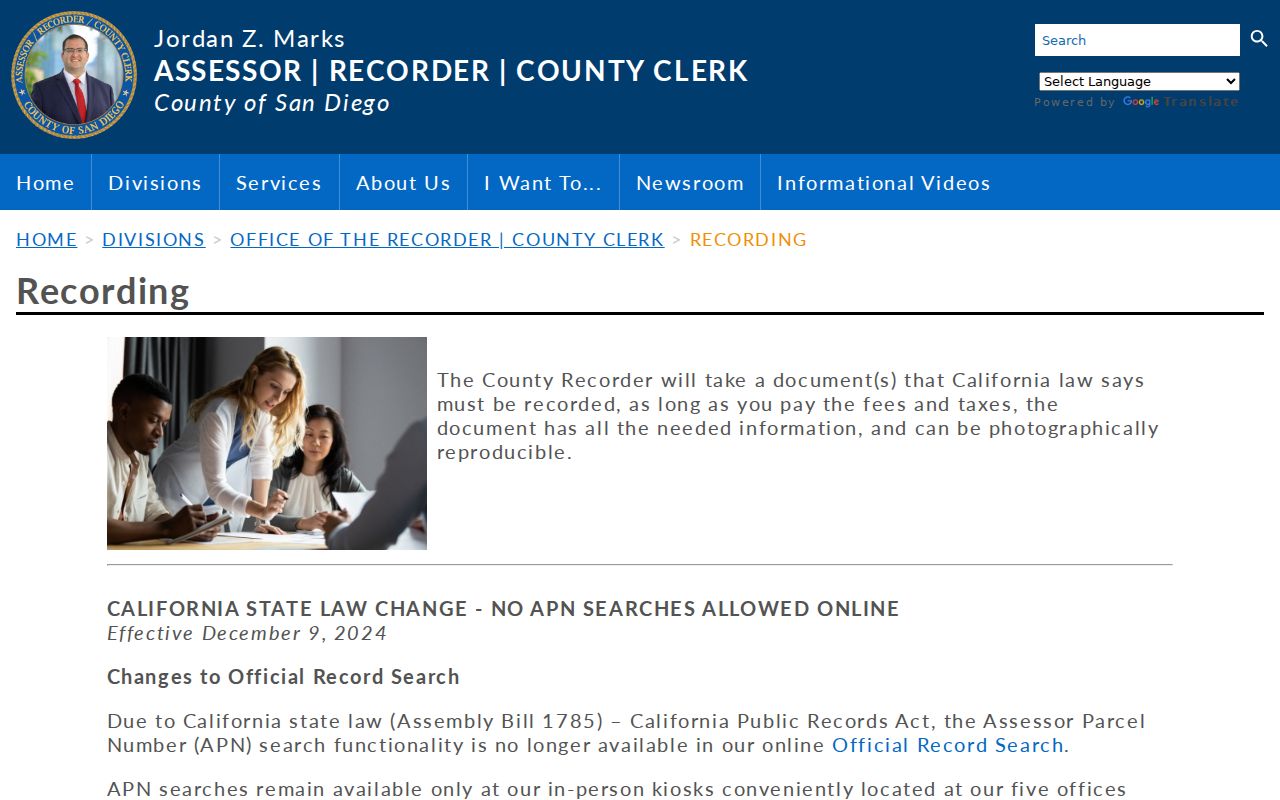
This view is a useful reminder that finding a promising index entry is only the first step toward reading the underlying record.
National City Property Search Geography
An old address can cross several systems before it yields a name. Start with the SanGIS Parcel Lookup Tool to turn a street address, intersection, or APN into parcel geography. Its layers can show jurisdictions, ZIP codes, districts, schools, community planning areas, and parcel boundaries. That matters near Lincoln Acres and other places where a National City label may not settle whether the city or county is the right custodian.
Next, use the secured assessment roll by parcel number, address, or street name for value and property context. Online ownership is withheld. ARCC says ownership and address information remain available by phone and at public computer kiosks. Assessor maps show dimensions, acreage, street widths, lot lines, adjoining parcels, and recorded map details, but not an owner or street address.
| Channel | Best Input | Useful Result | Name Access |
|---|---|---|---|
| SanGIS parcel map | Address, APN, intersection | Parcel and district geography | No direct owner result |
| Secured roll | APN, address, street | Assessed value context | Not online |
| Assessor phone or kiosk | Parcel or address | Ownership and property data | Public channel |
| Recorder index | Owner or prior owner name | Transfer and lien trail | 1970 to present online |
The ARCC property information page lays out the phone, kiosk, map, and mail options.
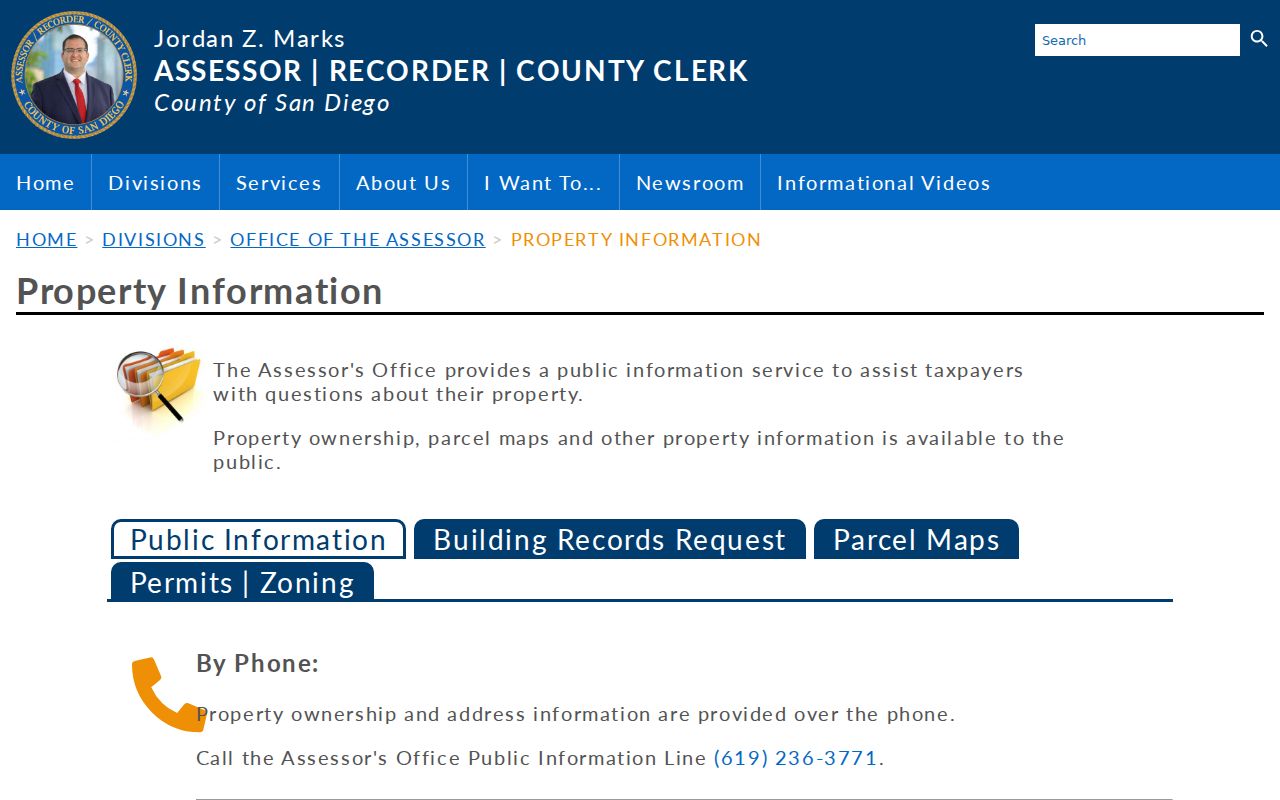
Using the map and web roll first makes a later phone or kiosk inquiry more precise because the APN is already known.
National City Court Name Lookup
The Superior Court of California, County of San Diego serves National City trial-court searches. Its Court Index accepts case type, case location, party type, beginning and ending filed year, last or business name, first name, and date of birth. Case types include civil, criminal, domestic, mental health, and probate. Search countywide when the location is uncertain because South County and central San Diego locations can both matter.
| Search Field | Input | Required | Use |
|---|---|---|---|
| Case Type | Category choice | Portal choice | Limits results to a court area |
| Case Location | Court region | Portal choice | South County or countywide search |
| Filed Years | Beginning and ending year | No | Narrows a common name |
| Party Name | Last/business and first | Core input | Finds indexed case parties |
| Date of Birth | Date | No | Helps separate similar names |
The online index generally reaches from 1974 forward, but it excludes juvenile cases and infractions. Some civil limited and misdemeanor material has shorter availability at certain locations. Central Division older-record indexes cover 1880 to mid-1974. The Register of Actions adds entries and some civil, small claims, and probate documents, while criminal documents and official copies still require court channels.
Note: The online court index is a locator, not the official record; bring the case number and photo identification when asking to view a hard-copy file.
National City Vital Records Paths
Births, deaths, and marriages tied to National City usually route first through San Diego County ARCC or the county health office. ARCC handles county births and deaths plus marriages licensed in San Diego County. California Department of Public Health is the statewide fallback, with birth and death coverage beginning in July 1905. A divorce decree comes from Superior Court; CDPH supplies only a certificate of record.
California uses authorized and informational copies under Health and Safety Code section 103526. An authorized copy requires an eligible requester and sworn statement, with notarization for a mailed request. An informational copy contains the same facts but is marked as invalid for establishing identity. That distinction can make an informational copy useful for family history without treating it as an identity document.
Public newspaper notices and library indexes may identify an event before a certificate order is placed. This can help confirm spelling, a date range, or a married surname and reduce the chance of paying for the wrong search. County fees in the research are $34 for birth, $26 for death, and $19 for marriage certificates.
Note: For an event outside San Diego County, contact the recorder in the county where the event occurred or the license was issued.
National City City Records Search
Municipal records add the names of officeholders, board members, petitioners, speakers, contract parties, permit contacts, and others who dealt with city government. National City publishes ordinances, resolutions, minutes, council agenda packets, contracts, employee-group memoranda, board and commission material, and Parking Authority records through its Laserfiche NCRecords library. Special topic sets include election history, past mayors and councils, Granger Music Hall, Stein Farm, Cruising, and Sweetwater Road or Plaza Bonita material.
Check those published sets and prior requests before opening a new request. National City NextRequest allows keyword searching of past requests and released documents, then accepts a new California Public Records Act request when the needed item is absent.
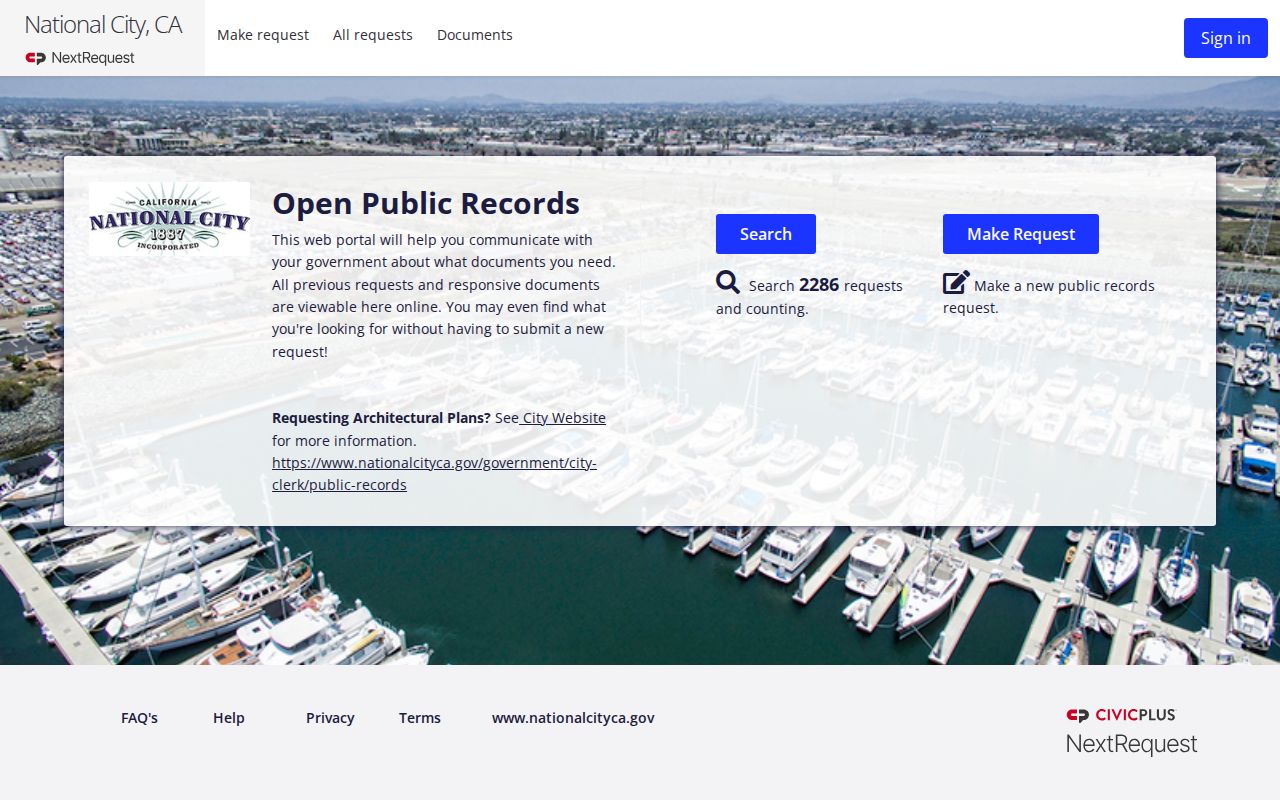
The published-request search can save time and also reveal the wording that produced a prior release.
National City Classmate Search
The Kile Morgan Local History Room gives former-classmate and family searches a rare city-level depth. Its yearbooks include National City High School from 1910 through 1920, Sweetwater Union High School from 1921 forward, National City Junior High from 1954 through 1991, and National City Middle School from 1992 forward. It also holds some Granger Junior High volumes plus runs for San Diego Academy and San Miguel School.
Start with a school and estimated year. Note the full name, spelling, activity, faculty name, and classmates shown near the person. Then compare those details with newspapers, city directories, and family manuscripts. The room also preserves San Diego County and city directories from 1889 through 1984, newspapers from 1882 forward, maps, photos, and organization directories. These sources can bridge a student name to an adult address or changed surname.
The Local History Room is on the second floor of National City Public Library and accepts research contact by email or through the Reference Desk. In-person hours are Tuesday and Thursday from 1:00 to 3:00 p.m., with appointments also available.
National City License Name Search
Professional and business records can confirm that a person used a certain name, held a credential, or was connected to a company. California's Department of Consumer Affairs search spans many licensed fields. The form accepts first name, last name, license number, business name, registry number, board or bureau, and license type. Results can show whether a credential is current, expired, suspended, or revoked.
The DCA advanced license search displays the filters used to separate people with similar names.
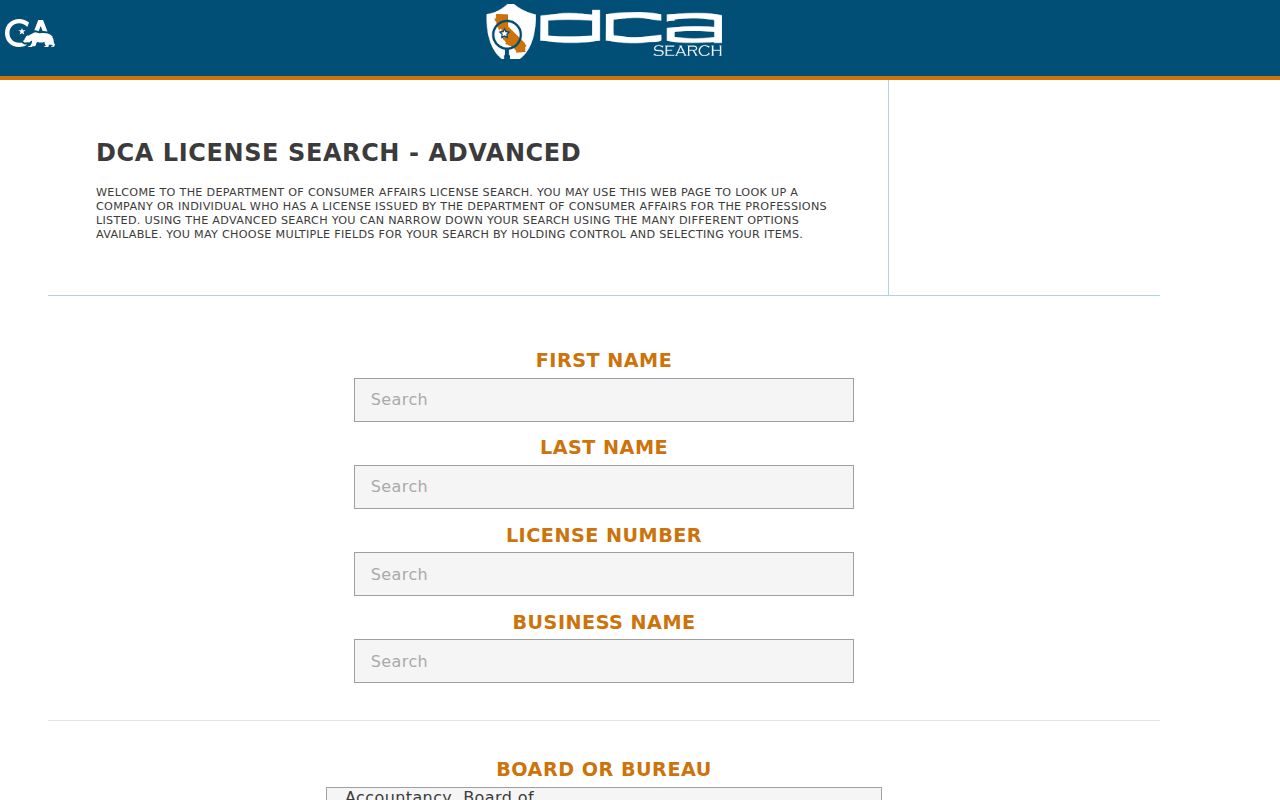
Board and license-type filters are especially helpful when a common surname produces too many results.
Different trades use different official tools. Contractors route through CSLB, attorneys through the State Bar, and corporations or LLCs through California SOS bizfile. San Diego County fictitious business name filings can connect a storefront name to registrants. National City permits may add applicants and project contacts, though a city request can be needed when the portal does not expose the record.
Note: License status can change, so confirm the current result with the board that issued the credential before relying on it.
National City Custody Record Searches
For current county custody, the San Diego County Sheriff's Who's In Jail tool searches last and first names, with a two-character minimum for each field. A public detail can include booking number, full name, birth date, age, physical description, and facility links. The sheriff warns that displayed release dates may be inaccurate while calculations are updated, so confirm a critical detail with the facility.
The Who's In Jail lookup shows the short name form and its verification control.
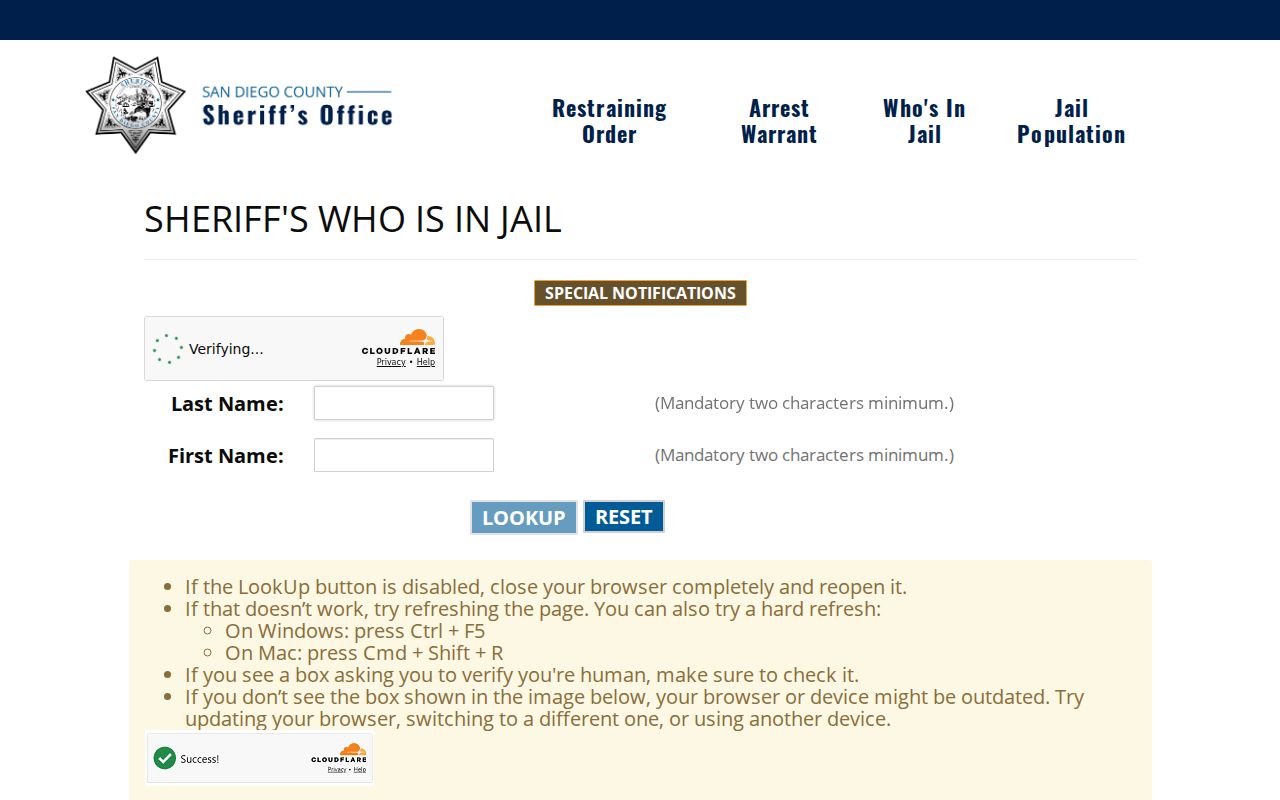
A match is a current custody lead, not a complete criminal history, and the same-name checks used for court records still apply.
California state custody uses CDCR's CIRIS search. A result may include the person's CDCR number, age, current location, commitment counties, admission date, and parole-hearing information. San Diego County also publishes a warrant query with partial-name matching, but it warns users not to attempt an arrest. Registry information carries its own strict statutory limits.
National City Voter Lookup Limits
Voter records are not an open address directory. The San Diego County lookup is meant to confirm a voter's own information using house number, birth date, street components, ZIP code, and party preference. Results can lead to voter information, vote centers, pamphlets, and elected representatives. A broader voter file requires an application, identification, an approved purpose, a fee, and security safeguards under California Elections Code sections 2188 and 2194.
The county file is limited to election, political, scholarly, journalistic, record-review, vendor, and governmental contexts defined by law. Personal use, solicitation, marketing, harassment, unsecured publication, and unauthorized transfer are barred. Driver's license data, state ID data, Social Security numbers, unique identifiers, and signatures remain confidential. The detailed process and confidentiality split are covered with the National City voter records lookup.
National City Records Before 1970
The recorder's online year is not the start of National City history. National City incorporated in 1887, and the Local History Room preserves Board of Trustees minutes from 1887, ordinances from 1887, maps reaching back to 1868, Sanborn map microfilm from 1887 through 1927, and deeds or mortgages from 1871 through 1940. County Archives holds official San Diego County material from the county's establishment in 1850 to the present.
Early residents may surface in Kimball family papers, railroad and wharf sources, chamber directories, school volumes, historic maps, and newspapers before a modern database can name them. Rancho de la Nacion, the Kimball brothers, and the Santa Fe railroad era are not just local color. They point to the record groups most likely to preserve a person's role in the city's first decades.
- 1850 onward: San Diego County Archives preserves official records, maps, vital material, and administrative files.
- 1871 to 1940: local deeds and mortgages identify parties, land, transfers, and financing.
- 1882 onward: local newspapers report obituaries, marriages, schools, clubs, and public notices.
- 1889 to 1984: city and county directories list residents, addresses, and occupations where available.
- 1910 onward: school yearbooks preserve students, faculty, activities, and cohorts.
Note: Do not assume an old street number stayed fixed; compare maps and directory volumes year by year because no verified citywide renumbering date was found.
National City Privacy Boundaries
Official records and commercial data collections are not equal. An official index points back to a named custodian and has defined access rules. A commercial compilation may blend public filings, marketing data, old phone or address histories, and other feeds. It can be stale, incomplete, or attached to the wrong person. Verify a match with the county, court, city, or state office that created the source record.
| Source Type | Strength | Main Limit | Best Use |
|---|---|---|---|
| Official index | Named custodian and filing trail | May omit the image or protected fields | Locate the original record |
| Phone or kiosk channel | May provide context withheld online | Requires direct office contact | Confirm property details |
| Library collection | Deep local history and long coverage | Often manual or in person | Trace older residents and families |
| Commercial compilation | Broad name and address aggregation | Possible stale or mismatched data | Lead only, then verify officially |
California also shields specific records. Safe at Home offers a substitute mailing address and confidential voter registration to eligible participants. Court rules limit remote access to some files. Vital records use authorized and informational copy rules. Property pages may suppress ownership or address fields online even when an office channel remains available. Respect each boundary and stop when the law or custodian restricts access.