
National City Voter Lookup Fields
The San Diego County Voter Information Lookup is the first stop for a National City voter checking personal registration details. It asks for address data and a birth date rather than a name alone. That design helps match one voter to the right registration. It also keeps the tool from acting like a public, browseable voter directory. Start with the address exactly as it appears on registration material, including any direction or street type.
| Lookup label | Control | Required | Entry guidance |
|---|---|---|---|
| Party preference | Selection area | Not marked | Appears before the address fields |
| House Number | Text | Yes | Enter the street number |
| Birth Date | Date or text | Not marked in static view | Used to match the voter |
| Pre Direction | Dropdown or text | No | Use only if the address has one |
| Street Name | Text | Yes | Enter the street name |
| Street Type | Dropdown or text | No | Street suffix or type |
| Post Direction | Dropdown or text | No | Use only if the address has one |
| Zip Code | Text | Yes | National City addresses commonly use 91950 |
Results are organized into tabs for voter information, vote centers, the voter information pamphlet, elected representatives, and a return to search. The California Secretary of State also offers a registration-status route and points voters to county tools. A person who cannot complete the web lookup can call the Registrar of Voters at (858) 565-5800. The county screenshot below shows the actual voter registration lookup rather than a general records search.
View the live fields at the county voter lookup source.
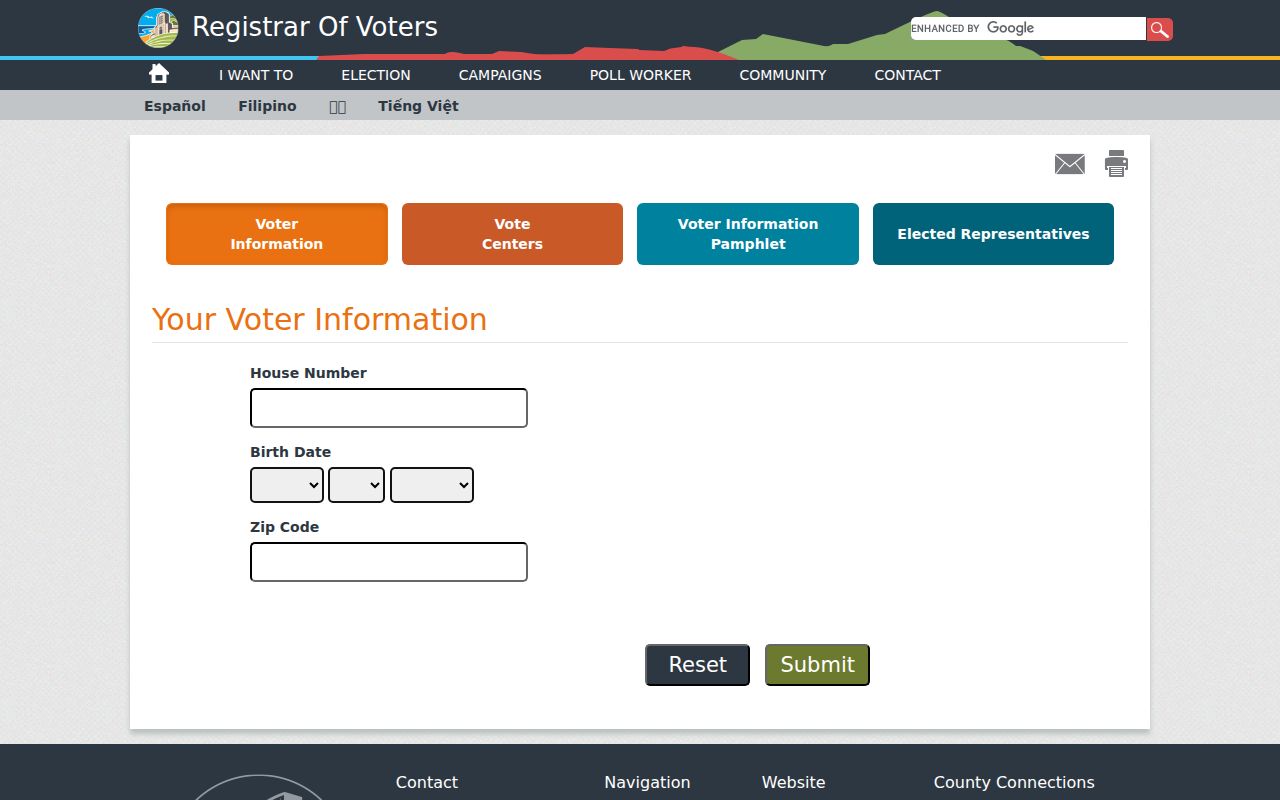
The field layout explains why a complete street format matters when a National City registration does not match on the first try.
National City Voter Office Roles
Two local offices have distinct election duties. The San Diego County Registrar of Voters administers National City voters, the registration database, county lookup, voter file requests, and election reporting. The National City City Clerk handles local nomination papers, measures, public notices, campaign finance and conflict filings, and city election information. Sending a registration-status issue to the city clerk adds a needless handoff. Registration and lookup questions belong with the county.
National City is a General Law City. Its mayor is elected at large, while four council districts shape local representation. Municipal elections occur in even-numbered years on the first Tuesday after the first Monday. These facts affect which local contest and elected-representative details appear after a voter completes the county lookup. They do not make the underlying voter rolls open to general browsing.
Note: Use the county for voter data and the city clerk for National City measures, filings, notices, and local election history.
National City Voter Record Fields
California regulations define a voter record broadly, but access depends on an approved request and purpose. A file can contain identity, location, contact, status, district, and participation fields when those values are present. Voting history means whether and how a person participated in an election. It never reveals a marked ballot or a vote choice.
| Identity and location | Registration county, registration ID, name, residential address, and mailing address |
|---|---|
| Contact | Phone number and email address, where present |
| Voter details | Language preference, date of birth, gender, and party preference |
| Registration state | Status, registration date, method, and status reason |
| Precinct data | Precinct and county voter ID number |
| Other fields | Place of birth, assistance request, and permanent vote-by-mail status |
| Participation history | Election date and voting method, but never ballot choices |
County e-pollbooks may verify name, address, birth date, preferred language, party preference, precinct, and vote-by-mail status. The county election plan states that those devices do not store a driver's license number or any reference to a Social Security number. That separation is one part of California's election privacy design.
Confidential National City Voter Data
California does not treat a voter registration affidavit as an ordinary public record. Elections Code sections 2188 and 2194, together with Government Code section 7924.000, restrict the residence and contact data in voter records. Approved access may be available for election, scholarly, journalistic, political, or governmental purposes. A signed application and a valid purpose are central to that access.
Confidential by law. Elections Code section 2194 and Government Code section 7924.000 protect driver's license and state ID numbers, Social Security numbers, unique identifiers, signatures, and covered voter contact data.
That boundary explains the difference between checking one's own National City voter registration and requesting voter data for an approved project. The first is a self-service lookup. The second creates security duties and limits on use, transfer, storage, and publication. General California records-law context belongs with National City public records access, while elections statutes control this record set.
National City Voter Roll Numbers
The California Secretary of State's 15-day Report of Registration for the June 2, 2026 Primary counted 28,855 registered voters in National City as of May 18, 2026. The report listed 13,206 Democratic, 5,717 Republican, 1,011 American Independent, 138 Green, 230 Libertarian, and 308 Peace and Freedom registrations. It also counted 253 as unknown, 174 as other, and 7,818 as No Party Preference.
More than one quarter of the National City voter roll in that report was No Party Preference. Party preference is a registration field, not a record of how someone voted. The totals are useful for civic context and trend work, but they do not authorize access to individual voter records. A later registration report may differ as people register, update addresses, or change preference.
Note: Registration reports are dated snapshots, so cite the report date whenever comparing National City voter totals across election cycles.
Protected National City Voter Registration
The California Safe at Home program gives eligible participants a substitute mailing address, mail forwarding, service of process, and confidential voter registration. Participants use a designated address with state, county, and city agencies. They should contact Safe at Home for the Confidential Voter Registration Form rather than use the normal public process without guidance.
Several Elections Code sections protect specific voters. Section 2166 concerns court-ordered confidentiality based on good cause and a life-threatening circumstance. Section 2166.5 covers Safe at Home participants, while sections 2166.7 and 2166.8 address certain public safety officers and qualified workers. Section 2166.9 protects residence, phone, and email data for covered elected officials and candidates, subject to narrow access rules.
A Safe at Home participant who misses the regular registration deadline may still register through Election Day, but the Secretary of State warns that the resulting registration will not be confidential. Timing therefore matters. The voter should work through the program before submitting ordinary registration material.
Request San Diego Voter Records
The county Application to Access Voter Registration Information covers the National City voter file. It requires an original wet signature and a clear copy of a current driver's license or state ID. Email and fax submissions are not accepted. Applicants must state a permitted election, political, scholarly, journalistic, record-review, or vendor purpose and explain how they will secure the records.
- Complete the county application, choose the precise product, and describe the approved purpose and safeguards.
- Attach the required photo identification, sign the original, and submit it by mail or in person to the Registrar at 5600 Overland Avenue, San Diego, CA 92123.
- Pay the applicable fee. The one-time county voter file delivered by FTP costs $75, while a search for up to ten specific voters is billed at $98 per hour with an estimate first.
- Allow 7 to 14 business days after receipt. Approved delivery may use electronic transfer, mail, or in-person pickup.
A daily or weekly vote-by-mail activity report for the current election costs $285. A specialized vote-by-mail report, including no-signature or mismatch-signature lists, costs $216. Printed lists add copy fees. Sharing the file requires a new application and express written approval from the Registrar.
California Statewide Voter File
The Secretary of State voter file request page is the statewide route. Candidates, qualifying committees, and people with election, scholarly, journalistic, political, or governmental purposes may apply. Submission requires an original signature, photo ID, supporting documents, and fee by mail or hand delivery. Fax and email are not accepted.
The statewide product is delivered on an encrypted DVD as three tab-delimited files: voter data, voting history, and district data. The charge is $15 per 1,000 records, with a $15 minimum and $100 maximum. Specific voter records cost $30 each, with a ten-record and $100 maximum. Approved specific-record results arrive through encrypted email or a protected archive, while full files use the encrypted disc. Processing is listed at 7 to 14 business days.
The official state request screen shows how tightly the voter roll channel is controlled.
Review the current requirements at the California voter information request source.
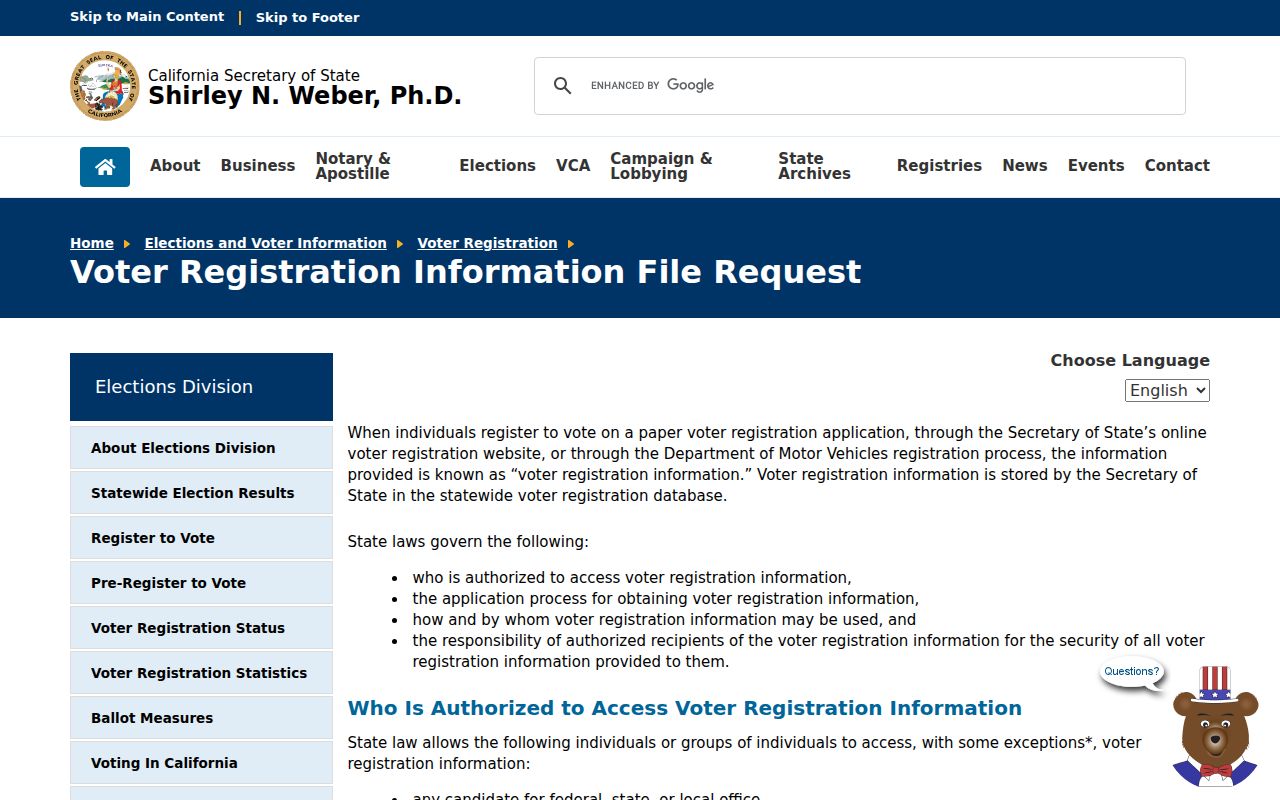
The state page is the right checkpoint before preparing ID, payment, and an original-signature application.
National City Voter Data Limits
An approved voter file may be used only for the stated purpose. California bars personal, private, commercial, advertising, solicitation, sale, and marketing use. Harassment of a voter or household is prohibited. Records cannot be placed on an unsecured site, passed to an unapproved person, or sold, leased, loaned, or delivered outside the narrow vendor rules.
Use carries a duty. Elections Code section 18109 makes knowing misuse, or acquisition without complying with the access rules, a misdemeanor.
Security duties include strong passwords, limited access, locked sessions within fifteen minutes, secure deletion, restricted physical access, and encryption on portable devices. These are not optional best practices added by a requester. They are part of the regulated access system. A National City voter records project should collect only the needed data and retain it only as long as the approved work requires.
Historic National City Voter Rolls
Older election research follows a different trail. California State Archives local-government holdings may include Great Registers, the historic voter lists used before modern databases. San Diego County election and turnout reports reach back to 1991. National City's Kile Morgan Local History Room adds newspapers, municipal election-history topics in Laserfiche, and Board of Trustees minutes from 1887 forward.
These sources help place a resident in a civic era without treating today's restricted file as an open genealogy tool. Start with a known year and election. Then compare a Great Register or county report with National City newspapers and minutes. Newspaper notices can name candidates, officeholders, petitioners, and election workers, while minutes show the city government context around a vote.
Note: Historical election sources vary by year and custodian, so ask the archive or library about the exact National City volume before visiting.