
National City Records Access at a Glance
National City is not the San Diego County seat, so the keeper of a record may be in National City, San Diego, or a statewide office. Municipal agendas, contracts, permits, police requests, and election-history files begin with the City Clerk. Recorded deeds, liens, fictitious business names, county vital certificates, property rolls, and archive holdings belong to the San Diego County Assessor/Recorder/County Clerk, known as ARCC. The Superior Court controls case files. California agencies handle business entities, state custody, professional licenses, and statewide vital records.
| Record group | Keeper | Web access | Practical access |
|---|---|---|---|
| Deeds, liens, judgments | San Diego ARCC Recorder | Official Records Index, 1970 to present | Free index; images at kiosks or by mailed copy order |
| City minutes, contracts, permits | National City Clerk and departments | NCRecords and NextRequest | Published file or California Public Records Act request |
| Property and tax roll | ARCC Assessor and Tax Collector | Secured roll, ParcelQuest, SanGIS, tax portals | Values online; ownership by phone or kiosk |
| Court and probate cases | San Diego Superior Court | Court Index; some Register of Actions files | Official and older files through a court location |
| Birth, death, marriage | ARCC, County HHSA, or CDPH | Forms rather than a broad public index | Authorized or informational copy rules apply |
| Jail and state custody | County Sheriff or CDCR | Current lookup tools | Public results with accuracy and misuse cautions |
| Business entities and UCC | California Secretary of State | bizfile Online | Free search and many free PDFs; certification costs extra |
Open does not mean unrestricted. Juvenile, sealed, adoption, confidential voter, medical, and protected-address material may be withheld or redacted. Court rules limit remote access to some case types, while vital records distinguish an identity-valid authorized copy from an informational copy. When part of a file is exempt, the California Public Records Act generally requires release of any reasonably separable nonexempt part.
National City Clerk Record Channels
The National City public records office gives municipal researchers two routes. NCRecords, the city's Laserfiche library, contains ordinances, resolutions, minutes, council agenda packets, agreements, employee group memoranda, board and commission material, and Parking Authority records. It also groups local topics such as election history, Granger Music Hall, Stein Farm, cruising, facility naming, Sweetwater Road, and Plaza Bonita. These topic files can surface names in a civic or property context even when no person-name database exists.
Search published records first. The National City NextRequest portal lets a visitor search earlier requests and responsive files that the city has already released, then submit a new request if the needed material is absent. Requests can also reach the city through channels such as email, mail, phone, fax, or an in-person visit, depending on the department. Permit and inspection files may begin in Cityworks or CForms, but a request is the fallback when an address-based portal does not expose the desired record.
Note: Architectural plans follow separate city release instructions, so ask the clerk about that process before requesting copies.
National City Names in Recorder Records
The San Diego County Official Records Index covers recorded real-property documents from 1970 forward. It is a grantor-grantee index. A grantor is the party giving or burdening an interest, while a grantee receives an interest or benefit. Those roles vary by document: a deed names transfer parties, an abstract of judgment can list the debtor as grantor and creditor as grantee, and a tax lien can place the taxpayer in the grantor field. Recently recorded items may take about 24 to 48 hours to appear.
The live portal could not be fully inspected during research, so only fields confirmed by ARCC material are listed. Search broadly when a surname has punctuation, a prefix, or a trust form. ARCC's own Owner Alert examples show that name format can change matching behavior.
| Confirmed search item | How it helps | Format note |
|---|---|---|
| Grantor or grantee name | Finds transfer, lien, judgment, and release parties | Try personal, business, and trust name forms |
| Document number and year | Retrieves a known filing precisely | Best for copy requests |
| Document type | Narrows deeds, liens, releases, and other instruments | Party roles change by type |
| Assessor parcel number | Connects a parcel to recorded instruments | Use the APN shown by county property tools |
Getting National City Recorded Copies
The recorder website shows index data, not the document image. After locating a filing, an online user can place it in a cart, create an account, and have a paper copy mailed to the address in the account profile. ARCC prints orders on the next business day and sends them by USPS, with general delivery in three to five business days. The office does not email or fax recorded-document copies. Public kiosks at ARCC offices are the direct viewing option.
A mail request should include the document number, recording year, at least one party name, and document type. The published recorder fee is $2 for the first page and $0.05 for each added page, plus $1 for certification. Certification is the clerk's official statement that a copy matches the held record. A mailed sales pitch charging far more for a deed copy should be checked against the official fee schedule before payment.
- Index
- A finding list that points to a filing; it is not the full filed document.
- Document image
- The complete visual copy of the recorded pages, available here by kiosk viewing or copy order.
- Certified copy
- A copy carrying the custodian's formal certification for uses that require official proof.
- Custodian
- The agency or office responsible for keeping and producing the record.
- Exemption
- A legal reason permitting or requiring an agency to withhold some information.
Note: Use the document number and recording year whenever possible; those details make a mail order far less ambiguous.
National City Property Records Offline
San Diego County separates quick web research from owner access. The secured assessment roll can be searched by parcel number, street address, or street name, but the county does not publish ownership in that online result. Ownership and address information remain available through the Assessor Public Information Line or at ARCC public kiosks. SanGIS adds parcel, jurisdiction, district, road, and ZIP layers, while Treasurer-Tax Collector tools add tax bill and special-assessment details. Some web results suppress situs or mailing addresses even when other official channels provide more context.
The secured assessment roll search offers a useful first pass before a phone call or kiosk visit.
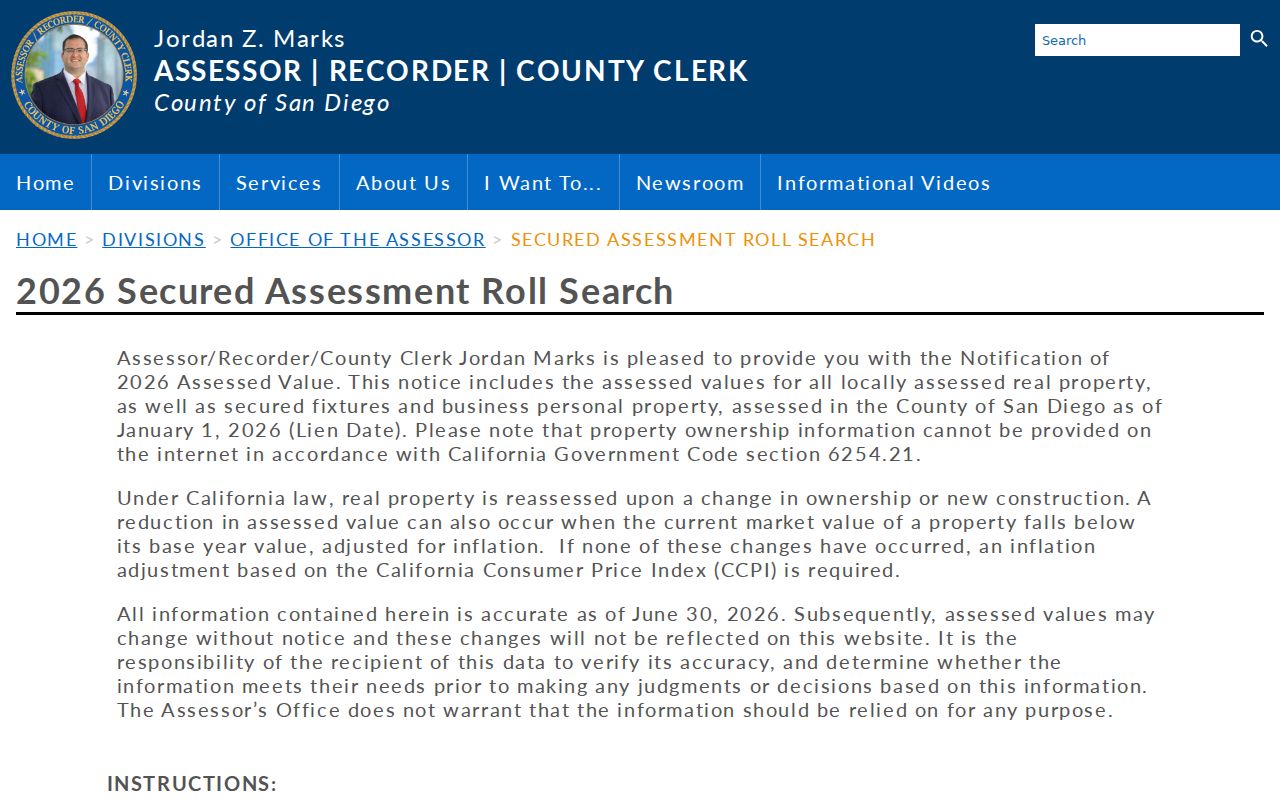
Its address, street-name, and parcel choices help identify the right APN, which can then anchor a recorder, map, tax, or in-person owner inquiry.
Use the right channel. An empty owner field online does not mean the ownership record is closed. Call (619) 236-3771 or use an ARCC kiosk for the public ownership channel.
National City Court Records Have Gaps
The San Diego Superior Court Index searches civil, criminal, domestic, mental health, and probate matters by case type, case location, party type, filed-year range, last or business name, first name, and date of birth. It generally reaches 1974 forward. National City matters may appear in South County or central locations, but a countywide search is sensible when the location is not known. The index gives a case number and court location; it is not the official record.
Not every file is online. Juvenile matters and infractions are excluded, and some limited civil or misdemeanor index records have shorter retention at certain locations. The Register of Actions provides deeper access to some civil, small claims, and probate cases begun in 2008 or later, yet criminal documents still require court access. Older Central Division indexes run from 1880 to mid-1974. A requester can view a hard file with photo ID and should bring the case number or party names. Court copies cost $0.50 per page, and the court does not email or fax files.
Note: A court docket is the chronological list of filings and events; it is not proof that every listed document is remotely viewable.
National City Vital Record Routes
Birth, death, and marriage certificates tied to San Diego County usually begin with ARCC or the county health agency. California Department of Public Health is the statewide fallback. CDPH holds statewide birth and death records from July 1905, public marriage certificates for 1905 through 1999 and 2008 through 2023, and certificates of divorce record. A divorce certificate is not the decree; the full decree comes from the Superior Court where the case was filed.
California Health and Safety Code section 103526 divides copies into authorized and informational forms. Authorized copies require an eligible requester and a sworn statement, with notarization for mailed requests. Informational copies contain the same record facts but are marked as not valid to establish identity. The CDPH application forms show the record-specific fields and proof rules.
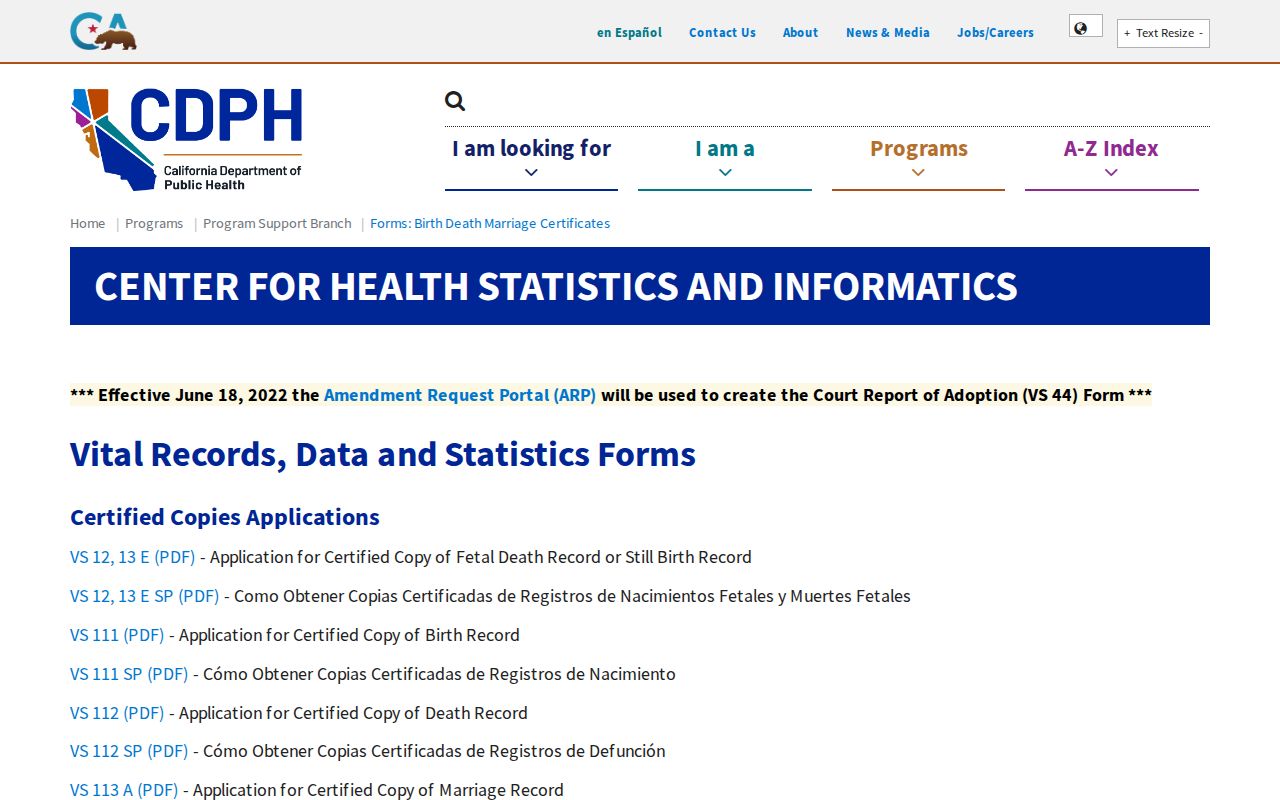
The form library makes the key choice clear before payment: select the correct event, custodian, and copy type rather than treating vital certificates as a single open index.
National City Public Records Offices
Three offices cover most local requests. City Hall handles National City-created files. ARCC handles county recorder, clerk, assessor, vital, and archive work. The Superior Court handles its own judicial case records rather than sending them through the City Clerk or Recorder. Call first when a trip depends on a hard file or kiosk, since the research did not establish one shared schedule for every county location.
National City Clerk
1243 National City Boulevard
National City, CA 91950-4301
(619) 336-4228
Monday through Thursday, 7 a.m. to 6 p.m.; closed Friday
San Diego County ARCC
Recorder, County Clerk, Assessor, and County Archives services
Recorder/Clerk: (619) 237-0502
Assessor information: (619) 236-3771
Superior Court Older Records
Central Division historic index and file routing
(619) 844-2400
Use for Central Division records from 1880 to mid-1974
Note: Probate records belong to the Superior Court, even though ARCC keeps many recorded property and vital documents.
National City Custody Record Lookups
Current county custody records are available through the San Diego County Sheriff's Who's In Jail search. It requires at least two characters in both first- and last-name fields and may show booking number, name, birth date, physical descriptors, age, and facility links. The sheriff warns that displayed release dates may be inaccurate while records are recalculated, so a facility should confirm time-sensitive information. The separate county warrant query accepts partial last, first, or middle names and warns users not to attempt an arrest.
State custody uses CDCR's CIRIS lookup, which may return a name, CDCR number, age, current location, commitment counties, admission date, and parole-hearing information. The California Megan's Law registry discloses only the information permitted by Penal Code section 290.46, and some registrants do not appear publicly. These tools support lawful personal safety and record confirmation. Their information must not be used to threaten, harass, or take unlawful action against anyone.
National City Business Filing Records
A National City business name may lead to two different custodians. California corporations, limited liability companies, limited partnerships, and many filing histories appear in the Secretary of State's bizfile Online. A local assumed business name may instead appear in San Diego County's fictitious business name index. FBN filing requires an original wet signature, can be made in person or by mail, and expires after five years. Search access is also available online, in person, or by mail.
The California business entity search provides free searches and many filing PDFs.
Entity number, status, agent, address, and filing history can distinguish a legal entity from a storefront name, while certified copies and certificates require the paid state ordering process.
Note: Search both the state entity database and county FBN index when a trade name does not reveal its legal registrant.
National City Records Before Online Indexes
The recorder index begins in 1970 and the court index generally begins in 1974, but National City's record trail is much older. The Kile Morgan Local History Room holds city and county directories from 1889 through 1984, newspapers from 1882 forward, city maps from 1868 through 2000, Sanborn map microfilm from 1887 through 1927, deeds and mortgages from 1871 through 1940, and early ordinances and Board of Trustees minutes. Those collections can bridge a name, address, school, business, or civic role across the years before modern databases.
San Diego County Archives preserves county activity from 1850 to the present and became the county's central permanent-retention archive in 2020. Older court files route through the court's historic record channels. For early National City research, library and archive access should lead, not trail, the web search. There is no verified local courthouse-fire story or countywide records-loss event in the source research, so a missing online result should not be mistaken for proof that the underlying record was destroyed.
Request National City Public Records
The California Public Records Act, Government Code sections 7920.000 through 7931.000, covers records held by state and local agencies. Any person may request an identifiable public record. An agency generally has 10 days to determine whether responsive records are disclosable. Unusual circumstances can add up to 14 days if the agency gives written notice. That period is for the disclosure decision, not a promise that every record will be produced in 10 days. Copy charges are generally limited to direct duplication cost unless another law sets a fee.
- Name the right custodian. Send city-created files to National City, recorded documents to ARCC, and case files to the court.
- Check the published source. Search NCRecords, NextRequest, the relevant index, or an agency reading room before filing.
- Describe the record. Give useful names, dates, addresses, case or document numbers, departments, and record types without demanding that staff answer questions.
- Choose inspection or copies. State whether electronic records, on-site inspection, plain copies, or certified copies meet the need.
- Review the response. If material is withheld, ask for the exemption and any reasonably separable public portion; narrowing an overbroad request may speed production.
Lawful personal use only. Open records do not authorize stalking, harassment, identity theft, unlawful access, or republication of protected data. California law places added limits on voter, registry, and computer-held information.
National City Records and Privacy
Public agency exemptions are only one privacy layer. California Safe at Home supplies eligible participants with a substitute mailing address, mail forwarding, confidential voter registration, and a designated address for dealings with public agencies. Court remote-access limits, vital-copy eligibility, voter confidentiality, protected home addresses, and redaction rules can also change what appears on the web even when an office holds a record.
Private data brokers are governed through California consumer privacy and data-broker laws rather than the CPRA request process. The state's Delete Request and Opt-out Platform, or DROP, launched for consumer deletion requests on January 1, 2026. Broker processing begins August 1, 2026, subject to legal exceptions. That service does not delete a deed, case, or other official government record. It addresses information maintained by registered private data brokers, which is a separate system from National City and San Diego County custodians.
Note: A private-data deletion request and an agency records request operate under different California laws and reach different custodians.